

Hey! How can we help?
02:10HYROX stations and race format
Nathan Britten | Oct 12, 2026 | Uncategorized
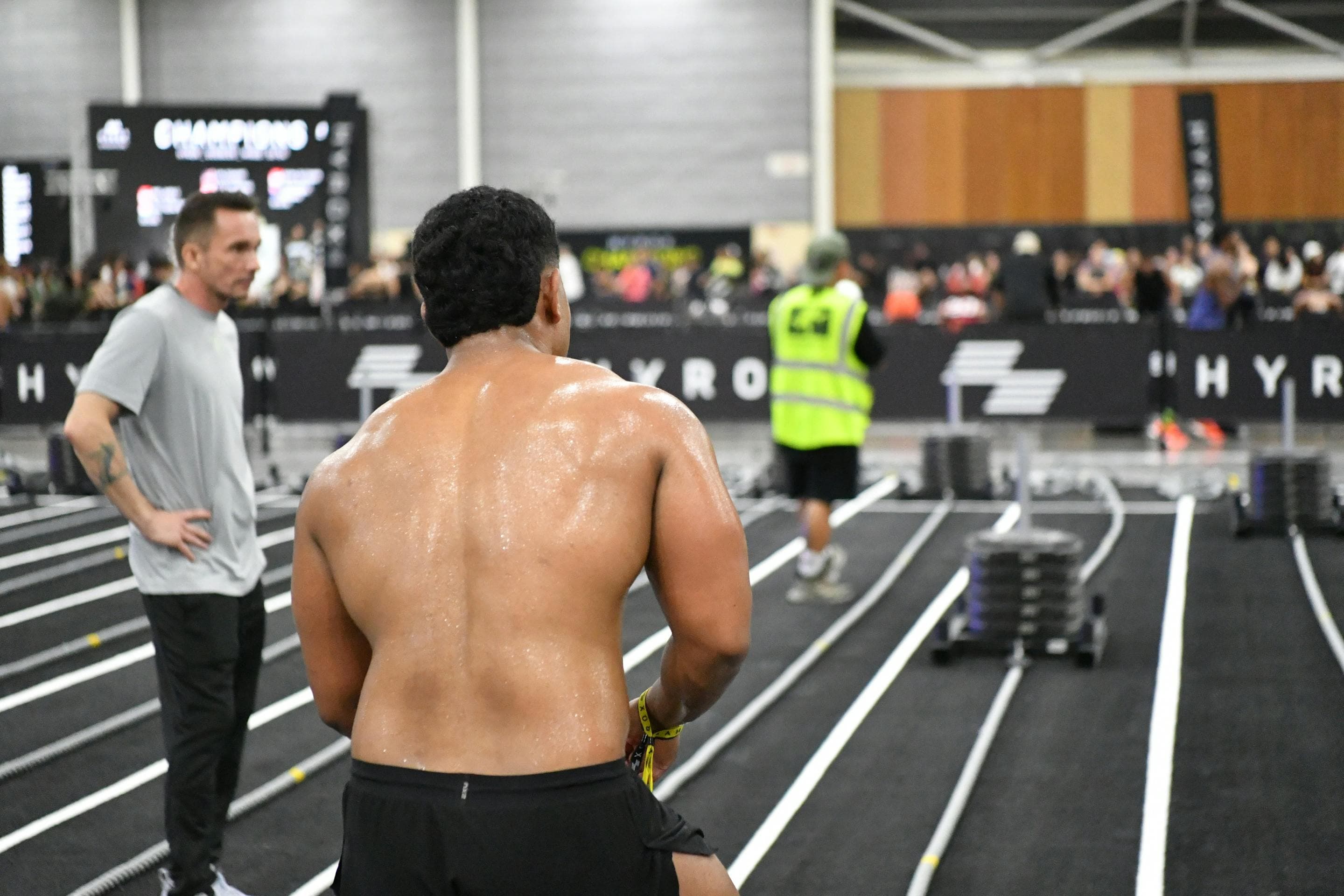
A HYROX race is eight runs and eight stations, always in the same order. This page is that format: what you do, how far each piece is, and the rules that decide whether a station counts. For what the word itself means, see what HYROX stands for. The loads are on HYROX weights by division. Figures below are from the HYROX Singles Rulebook, Season 26/27.
HYROX race format
You run 1 km. You complete one station. You repeat that until you have done eight runs and eight stations. The running distance is 8 km in every division. Women, men, women pro, and men pro all run the same distance. Pro does not add a ninth station or a longer run. It changes the weight on some of the stations.
The course is three parts, and they are not the same thing. There is the run course, the Roxzone, and the workout station. The Roxzone is the ground you cross between the end of a run and the start of the station, and again when you leave the station for the next run. It is not station number nine.
The order is fixed. SkiErg, sled push, sled pull, burpee broad jumps, rowing, farmers carry, sandbag lunges, wall balls. You do them in that sequence, with a 1 km run before each one. Wall balls are last. There is no run after them. Missing a station, or failing to finish one, is a disqualification. Doing stations out of order is a 3-minute penalty. More than one station out of order is a disqualification. You are allowed to go back and complete a missed station before you enter the wall balls, but the penalty still applies.
A judge assigns your lane and your equipment. You do not pick your own sled, rower, or wall-ball target. On the lunges, the burpee broad jumps, and the farmers carry, lane lines are a guide. A faster athlete can pass when it is safe. On the sleds, you stay in the lane you were given.
HYROX stations
Distances and reps are the same in every division. The table is the race. Technique for each station is linked. Weights are not in this table, because Open and Pro do not share them.
| Order | Station | Work | Technique |
|---|---|---|---|
| 1 | SkiErg | 1,000 m | SkiErg technique |
| 2 | Sled push | 4 × 12.5 m | Sled push technique |
| 3 | Sled pull | 4 × 12.5 m | Sled pull technique |
| 4 | Burpee broad jumps | 80 m | Burpee broad jump technique |
| 5 | Rowing | 1,000 m | Rowing technique |
| 6 | Farmers carry | 200 m | Farmers carry technique |
| 7 | Sandbag lunges | 100 m | Sandbag lunge technique |
| 8 | Wall balls | 100 reps | Wall ball technique |
Read that as a loop. Run, SkiErg, run, sled push, run, sled pull, run, burpee broad jumps, run, row, run, farmers carry, run, sandbag lunges, run, wall balls, finish. The first run is the only one you start fresh. Every run after a station is done with whatever that station just cost you. That is why the order matters for training, not only for race day. You never ski after the sled. You always row after the burpee broad jumps. You always wall-ball after the sandbag lunges.
The SkiErg and the rower both start with the damper on 6, in every division. You can change it during the piece. On the SkiErg both feet stay on the base. You may lift them, and you may jump, but when a foot comes down it has to land on the base, not the floor. Heels can hang over the edge. They cannot touch the floor. A foot on the floor is a warning the first time, then a 15-second penalty each time after that. You stay on the platform and raise an arm when the distance is done. You leave only after a judge confirms it. On the rower you stay on the seat until the monitor shows 1,000 metres and a judge has confirmed it. You can stop, put the handle back, and rest. You cannot stand up or leave the seat early.
HYROX exercises
Each station is a set task with a standard the judge can see. The standard is what makes a rep or a length count. Doing something that looks similar is not enough.
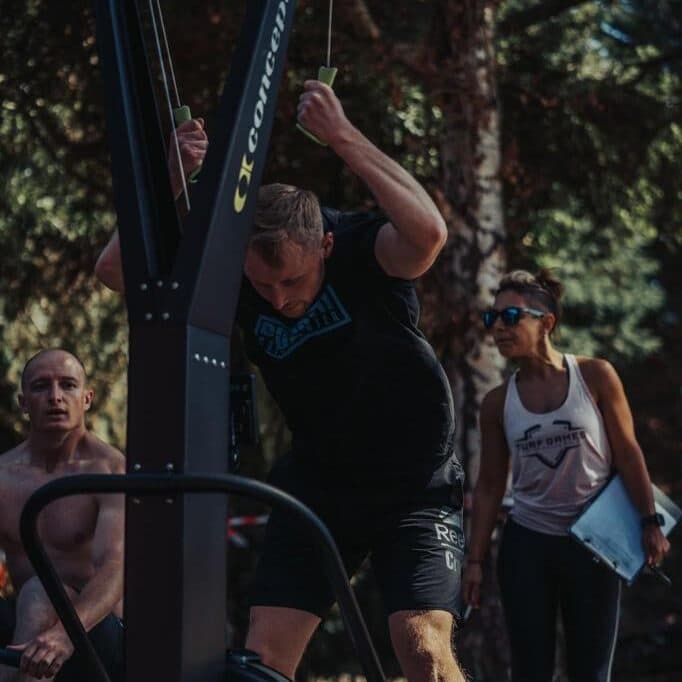
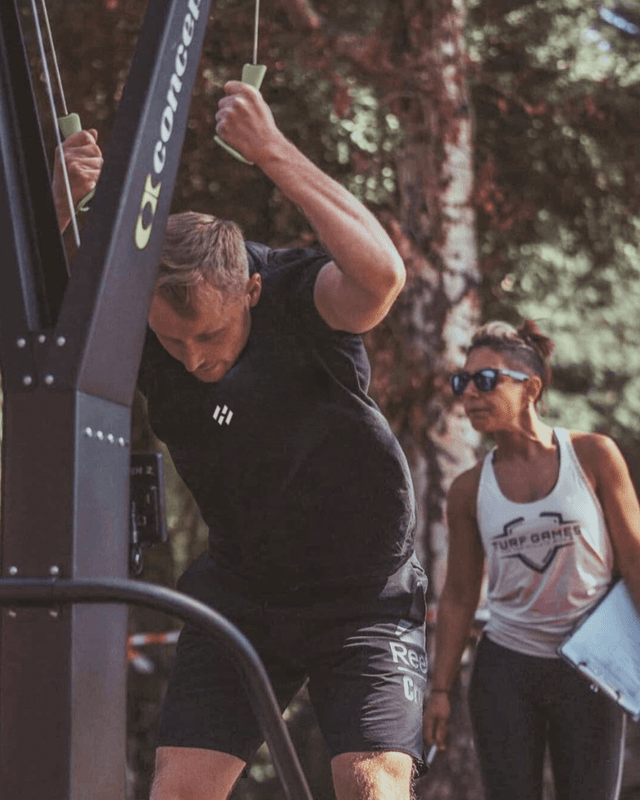
SkiErg, 1,000 metres. This is the first station, so it follows the only fresh kilometre. You are on the machine until the distance is done. The damper note above applies here. The piece is the same length for Open and Pro. Nothing gets added because you entered Pro.
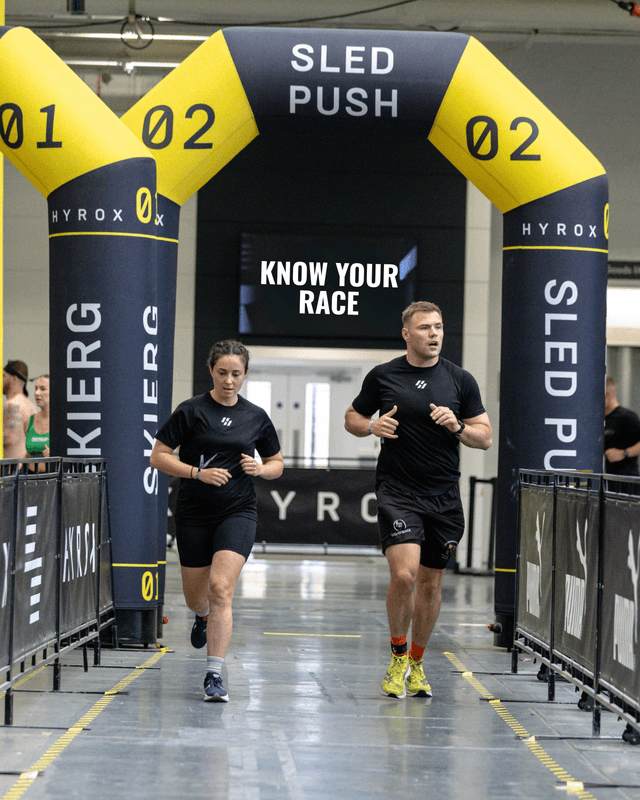
Sled push, four lengths of 12.5 metres. That is 50 metres. A judge gives you a lane and a sled. The whole sled has to cross the line at the end of each length before you turn. Stopping with the sled short of the line means you still have that distance to push. The published weight includes the sled itself. It is not the weight of the plates on top of an unnamed sled.
Sled pull, four lengths of 12.5 metres. Same 50 metres, pulled rather than pushed, and a lighter weight than the push in every division. You are still in an assigned lane. How you pull is covered in the technique article. The rule that does not change is the distance and the fact that the published kilogram figure already includes the sled.
Burpee broad jumps, 80 metres. There is no external weight. Every burpee needs the chest on the floor. The rulebook defines that as the nipple line making clear contact. Both feet have to leave the ground and land together on the broad jump. A stagger of more than 5 cm between the feet is not allowed, and you cannot add extra steps or shuffles. When you step or jump out of the bottom, your feet cannot go past your fingertips. On the burpees after the first, your hands start no more than 30 cm in front of your toes. You may use a knee to stand up from the bottom. The length of each jump is your choice. The station is finished when you have covered 80 metres, not when you have done a set number of jumps.
Rowing, 1,000 metres. Same rules for every division. Stay seated until the distance is complete and confirmed. Rest is allowed on the seat. Standing is not. This station comes after 80 metres of burpee broad jumps, so the legs you row with are the legs you just jumped on.
Farmers carry, 200 metres. One kettlebell in each hand, arms extended by your sides. Both kettlebells stay with you while you move. You can put them down to rest, as long as they do not shift forward when you set them down. The station is finished when you have carried them across the line and returned them to the correct box with the handles upright. Leaving them down, or with the handles the wrong way, is a 30-second penalty if you do not correct it before you leave the Roxzone. Using the wrong weight means you repeat the whole station. The colours in the rulebook are white, grey, and black, matching women, men and women pro, and men pro.
Sandbag lunges, 100 metres. One sandbag, carried for the full distance. The bag has to stay supported by you. Setting it on the floor, a barrier, or your feet so you can unload it is a 15-second penalty each time. The wrong sandbag means you repeat the station. The same white, grey, and black pairing applies.
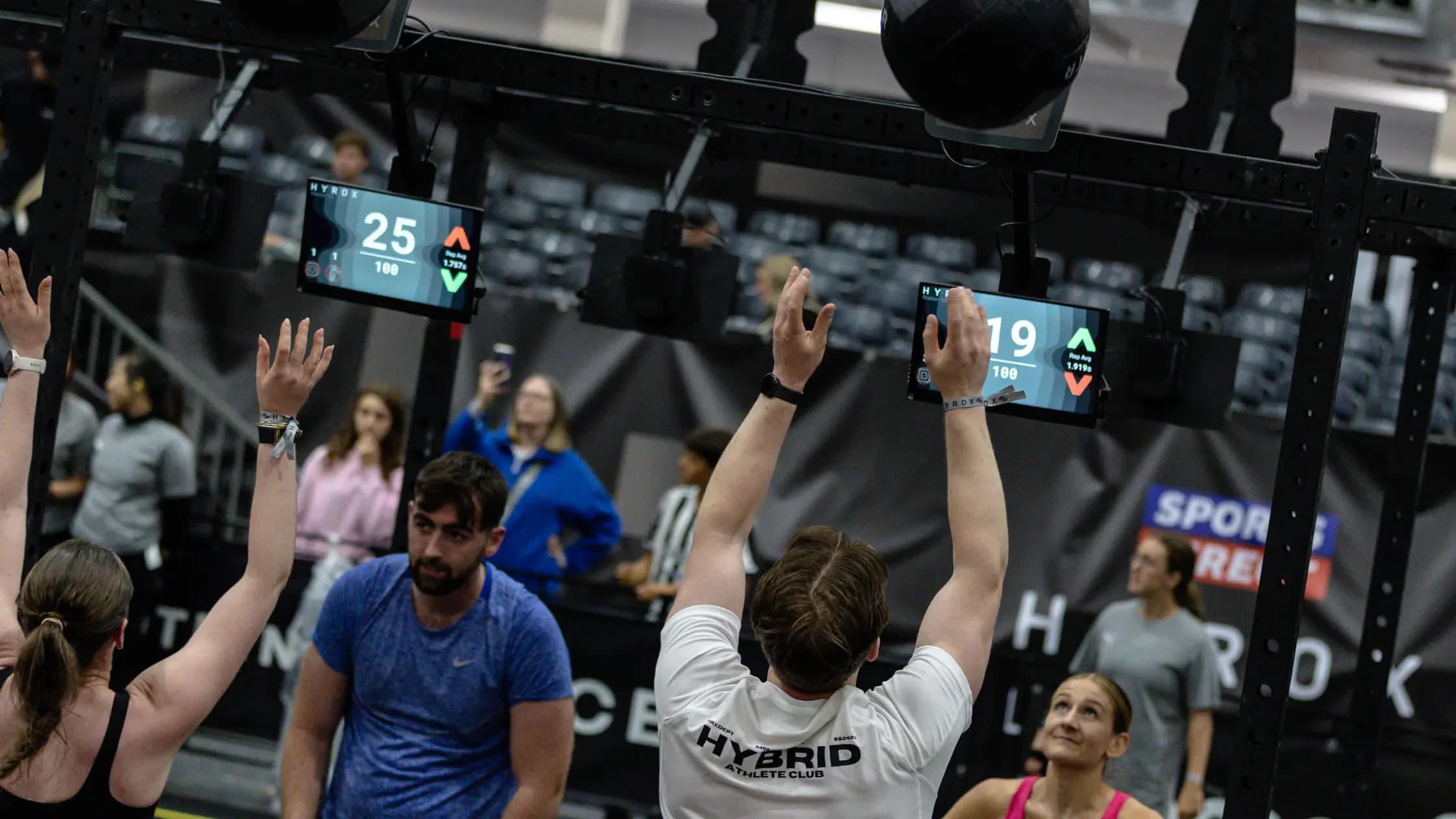
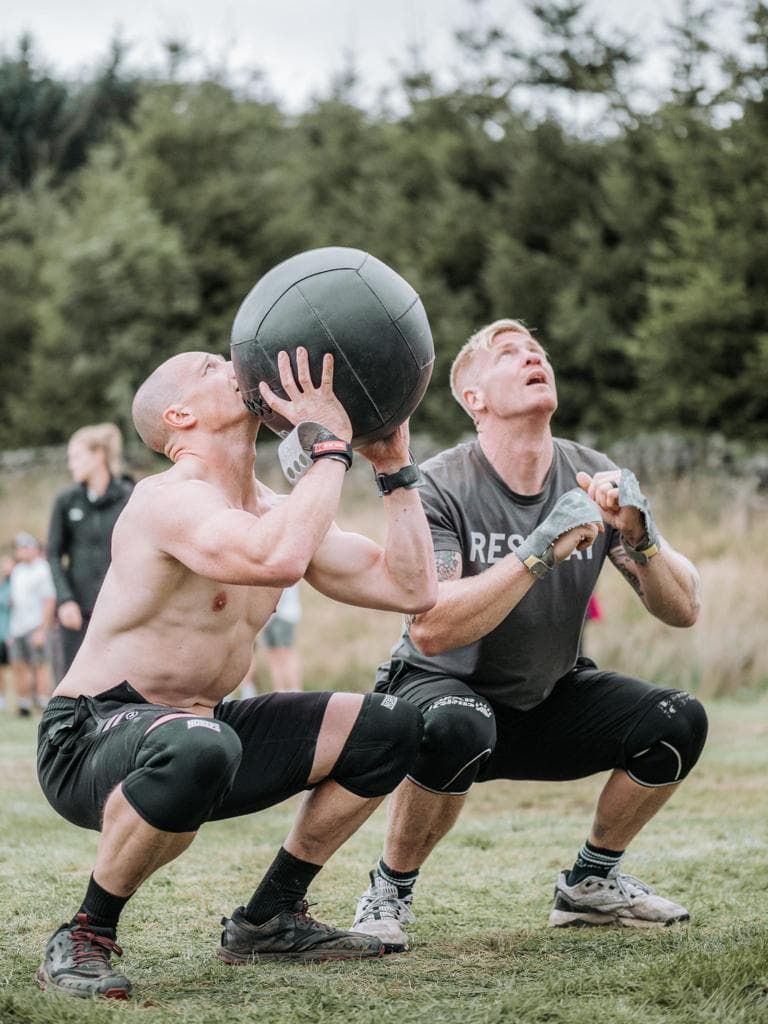
Wall balls, 100 reps. You start standing tall, hips and knees straight, ball in both hands. Picking the ball up and throwing it in the same motion does not count. Each rep is a full squat, hips below the knees, then a throw that hits your target. Women and women pro throw to 2.70 metres. Men and men pro throw to 3.00 metres. After the ball hits, you either catch it and go again, or you let it bounce and start the next rep from tall. Catching the ball on the bounce and continuing is not a rep. There is no warning system here. A rep meets the standard or it is a no-rep. You may take your shoes off once you are at your target, and you put them under the rig. When you finish, you take the shoes with you. You do not come back for them.
Open, Pro, and doubles
Open and Pro share this page. The order, the runs, the SkiErg, the burpee broad jumps, and the rower do not change. Pro is a heavier sled push, sled pull, farmers carry, sandbag, and wall ball. Those numbers are in the weights article, not repeated here as a second list.
Doubles use the same station distances and the same loads as the matching singles division. Doubles women match women. Doubles men, mixed, and women pro match men and women pro. Doubles men pro match men pro. In doubles you can share the work. The rules for where the resting partner stands are specific to each station, and they are on the technique pages. The station is not complete because one partner did most of it, if the rulebook requires both people in a set position before reps count.
If you want a target time for this exact order of work, use the HYROX race calculator. If you want to practise the order before race day, find a HYROX simulation. A simulation is the same sequence. A normal gym session that includes some of these movements is not.
Related Posts


Our Tools
Leave nothing to Chance!
Our tools review your performances, optimise your training and strategise your races


Hey! How can we help?
02:10Didn't Find what you're looking for?
Drop us a message on WhatsApp or ping us an email. We usually reply within the hour.