

Hey! How can we help?
02:29HYROX vs CrossFit
Nathan Britten | Oct 12, 2026 | Uncategorized

HYROX and CrossFit both use a mix of running or rowing and functional movements. They are not the same event. This page is the difference in format: what you show up to do, how it is scored, and which parts of one prepare you for the other. It is not a ranking of which is harder.
HYROX vs CrossFit
HYROX is one race. The stations, the order, and the running distance are published and they stay published. You can read them the year before you enter. CrossFit is a method of training and a sport whose workout changes. The session you do on Tuesday in a gym is not the session from last month, and it is not automatically the workout at a competition.
The result of a HYROX race is a finish time. You start, you complete the course, the clock stops. A CrossFit workout might be scored for time, for reps completed in a set window, or for the load you lift. Two people can both “do CrossFit” in a given week and not have done the same workout at all. Two people in the same HYROX division, in different cities, are doing the same eight stations and the same 8 km of running.
That single difference decides how you train. For HYROX you can practise the list. For CrossFit you train so that an unknown combination is still possible. Spending a year getting good at a changing class workout does not mean you have practised a 152 kg sled push for 50 metres, or 100 wall balls after sandbag lunges, unless those things happened to be in the sessions you attended.
HYROX race format
The HYROX race format is a 1 km run followed by one station, eight times. The stations, in order, are the SkiErg for 1,000 metres, a sled push for 50 metres, a sled pull for 50 metres, burpee broad jumps for 80 metres, a row for 1,000 metres, a farmers carry for 200 metres, sandbag lunges for 100 metres, and 100 wall balls. The full standards and the Season 26/27 loads are on HYROX stations and race format and HYROX weights by division.
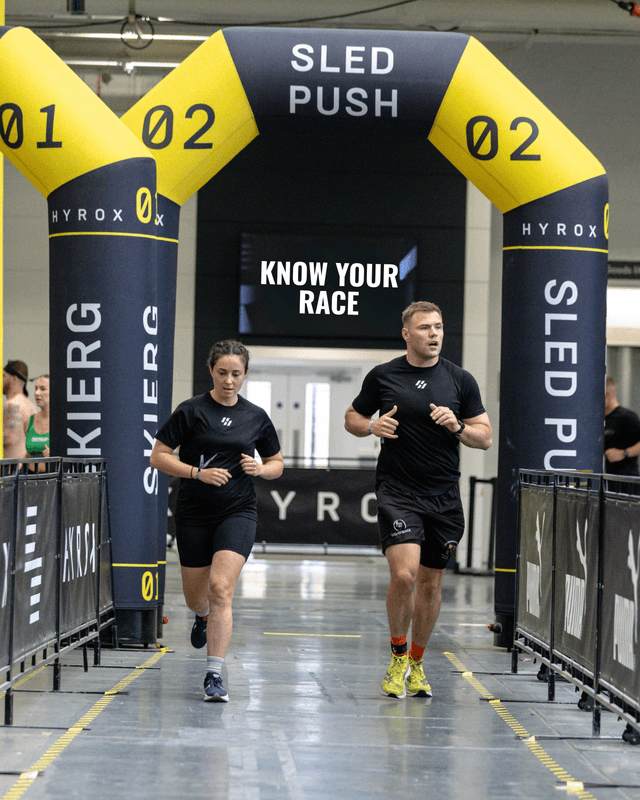
You do them in that order. Missing a station is a disqualification. The running is 8 km in every division. Open and Pro do not change the order. Pro changes the weight on the sleds, the carry, the sandbag, and the wall ball. Between each run and each station you pass through the Roxzone. That is part of the course, with an IN arch and an OUT arch, not a rest area you can use however you like.
Because the list is fixed, a HYROX simulation can copy it. You can fail at a specific station, know which one it was, and train that station before the race. You can also set a finish time in the HYROX race calculator and see how that time usually splits across the runs and the stations. The calculator is a way to read a target. It does not change the fact that the race is the same sequence every time.
What a CrossFit workout changes
A CrossFit class is built around a workout that the gym posts for that day. The movements might include a barbell, gymnastics, a run, a row, or a carry. Next week the combination is different. You get better by seeing a lot of combinations, not by repeating one published race until the order is boring.
Competition is another step on from the class. The CrossFit Open, a local throwdown, and the Games are not the HYROX season. They do not use the HYROX station list, the Roxzone, or a single finish time that includes eight 1 km runs and eight set stations. If someone tells you a CrossFit competition “is basically HYROX,” ask them whether the workout was announced as this exact order, with these distances, in every city. If it was not, it is a different event that happens to share some equipment.
Scoring changes with the workout. You might be trying to finish a piece as fast as possible. You might be trying to do as many rounds as possible before a clock runs out. You might be trying to lift more than the person next to you. HYROX does not switch scoring systems between races. Faster time wins, inside your division.
What you can take from one to the other
A lot of the engine transfers. If you can run, row, and ski without falling apart, those 1,000 metre pieces in HYROX are not a new sport. If you can squat below parallel and throw a ball to a target, the wall-ball standard will make sense. Burpees, lunges, and carries show up in both. A person who has done those for years does not start HYROX from zero.
What does not transfer automatically is the sled and the order. The sled push and sled pull are 50 metres each, four lengths of 12.5 metres, at a set weight that includes the sled. Many CrossFit gyms own a sled. Fewer of them ask you to push the men’s Open load of 152 kg, or the women’s Open load of 102 kg, for the full 50 metres, then run a kilometre, then pull 103 kg or 78 kg. If your gym’s sled work is a few short pushes at whatever plates were on it, you have not done the station.
The compromised kilometre does not transfer either, unless you have been running immediately after those stations. In HYROX the run after the sled push is still 1 km. It is not a 200 metre jog to the next barbell. People who are strong in a class and slow in HYROX are often slow because the runs after the stations are a skill they have not practised, not because they lack a deadlift.
The wall ball is a good example of a shared movement with a different standard. HYROX wants 100 reps, hips below the knees, to a set target: 2.70 metres for women and women pro, 3.00 metres for men and men pro. The ball is 4 kg, 6 kg, or 9 kg depending on division. A gym that throws to a lower line, or for 20 reps in the middle of a circuit, has taught the pattern. It has not taught the hundredth rep after sandbag lunges.
Who each format suits
Choose HYROX if you want a known list and a clock. You can write the eight stations on a card, train them, and turn up to the same card in another city. The boredom of repeating the sled is the point. You find out whether you are getting better at this race, because the race did not change underneath you.
Choose CrossFit if you want the workout to change. You will squat, pull, run, and do skill work in combinations you did not see coming. You will get broadly fit. You will not, by default, have rehearsed the HYROX order.
Doing both is coherent if you are honest about what each session is for. A CrossFit class can be the strength and the general fitness. It does not replace the compromised runs, the sled distances, or a simulation of the full order. If HYROX is the race you paid for, some of the week has to be the race. The HYROX vs Spartan page is the same kind of comparison for obstacle racing, which is a third format again: outdoor, variable terrain, and obstacles that are not this station list.
Related Posts



Our Tools
Leave nothing to Chance!
Our tools review your performances, optimise your training and strategise your races




Hey! How can we help?
02:29Didn't Find what you're looking for?
Drop us a message on WhatsApp or ping us an email. We usually reply within the hour.