

Hey! How can we help?
02:29Roxzone HYROX: what it is
Nathan Britten | Oct 12, 2026 | Uncategorized

The Roxzone is the part of a HYROX course between the run and the workout station. The Season 26/27 rulebook describes every course as three pieces: the run course, the Roxzone, and the stations. This page is those crossings. It is not a list of the eight stations. Those are on HYROX stations and race format. The rulebook does not publish a Roxzone distance or a standard time to get through it, so this page does not invent one.
What is the Roxzone
You finish a kilometre. You are not yet on the SkiErg, the sled, or the rower. The ground between that finish and the station is the Roxzone, and you will cross it again when the station is done, on the way to the next kilometre. It happens eight times on the way in and, after every station except the wall balls, on the way out.
It is easy to treat that ground as dead time. It is not a station, so it has no reps. It is also not nothing. You are still on the clock. You are still on a marked route. The next station does not start because you can see it. It starts when you are on the equipment, under the standard for that station. Until then you are in the Roxzone, walking or running the route the arches set.
Water is available at least once on each pass, during the pass or just before or after it. A sports drink may be there as well. Anything you want to eat, you carry from the start. The rulebook does not provide a nutrition station you can rely on. Cups and gel packets go in the bins. Leaving them on the Roxzone floor or on the run course can be a 2-minute penalty. Spitting or clearing your nose onto the floor is the same penalty.
Roxzone HYROX
The first pass is the calm one, and it is worth using it to see the route. You have run 1 km. You come in fresh, relative to the rest of the day. Ahead of you is the SkiErg, 1,000 metres, damper starting at 6. You find your lane, you get on, you ski. When you finish, you leave through the OUT arch and start the second kilometre. That second kilometre is the first compromised run. The Roxzone did not cause that. The SkiErg did. The Roxzone is just where you were standing when the effect started.
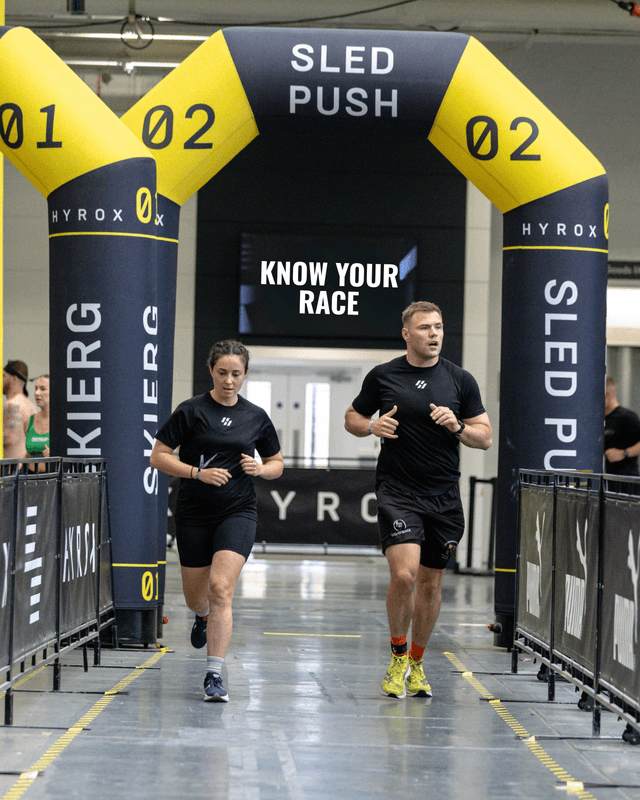
The second pass brings you to the sled push. A judge assigns the lane and the sled. You do not choose a sled that looks lighter. Four lengths of 12.5 metres, the whole sled across the line each time. Then out, and the third kilometre. The third pass is the sled pull, another 50 metres, lighter than the push, still in an assigned lane. Then the fourth kilometre.
The fourth pass is the burpee broad jumps, 80 metres, no external weight, chest to the floor, feet leaving and landing together. The fifth pass is the rower. You stay on the seat until 1,000 metres is confirmed. The sixth pass is the farmers carry, 200 metres, one kettlebell in each hand. If you put the bells down, they cannot creep forward. You return them to the box, handles up, before you leave. Getting this wrong and failing to fix it before you exit the Roxzone is a 30-second penalty. The Roxzone is the last place you can correct that, which is a useful way to understand it: some station mistakes can still be fixed before you cross out.
The seventh pass is the sandbag lunges, 100 metres, the bag staying on you. The eighth pass is the wall balls, 100 reps, and then the finish. There is no ninth kilometre. You may take your shoes off at the wall-ball rig. You take them with you when you go to the finish. You do not return to the station after the race to collect them.
By the eighth pass, the route you saw on the first pass is the same route with worse legs. The arches have not moved. The decision that was easy when you were fresh, which opening to use, is the decision people get wrong when they are looking at the floor. The timing system can read the chip and record the wrong arch without a judge having to watch you do it.
The IN arch and the OUT arch
The Roxzone has an IN arch and an OUT arch. You enter through IN and you leave through OUT. Entering through the OUT arch, or leaving through the IN arch, is a 2-minute penalty each time. Two wrong crossings are four minutes. That is not a small bookkeeping error on a race that people train months for.
Do it on the first pass, while you can still think. Watch which arch the people in front of you are using, and check it against the sign rather than against the crowd. A crowd can be wrong, and a crowd can be in a different division with a different path through the same hall. Your chip is the one that will be read.
You also stay out of the Roxzone before your start. Entering it early can start the chip and produce a time that is not the race you ran. The same is true of the run course. The warm-up area is not the Roxzone. Spectators are not in the warm-up area. Ten minutes before your wave you are at the start, not wandering the course to see the sleds.
The Roxzone and compromised running
The station and the run are different jobs, and the Roxzone is the hinge. You arrive from a kilometre. You do the station. You leave into another kilometre, except after the wall balls. The run you leave into is compromised: your legs and your breathing are already busy. How that run should be trained is in compromised running. The short version is that you only run fresh once. Practising eight easy kilometres does not teach you the seven runs that follow a station.
People lose time in the Roxzone in ordinary ways. They stand at the water table and drink as if the clock had stopped. They walk the long way because they did not look at the arches on the first pass. They finish the farmers carry and leave the kettlebells in the wrong place, then either take the penalty or go back. None of that is a station rep. All of it is on the same clock as the sled.
You cannot train the exact arches in a normal gym, because your gym does not have the IN and OUT of that venue. You can train the habit the arches are testing: finish the station to the standard, then go straight to the run. In a compromised session, the moment you finish the sled or the wall balls, you start the run. The gap you leave there, chatting or sitting, is the gym version of a long Roxzone. On race day, make the crossing as direct as the arches allow, take water if you need it, and get to the next kilometre. The station standards still apply. Rushing a wall ball so you can leave faster, and losing the rep, costs more than the two seconds you saved in the Roxzone.
Related Posts



Our Tools
Leave nothing to Chance!
Our tools review your performances, optimise your training and strategise your races



Hey! How can we help?
02:29Didn't Find what you're looking for?
Drop us a message on WhatsApp or ping us an email. We usually reply within the hour.