

Hey! How can we help?
02:29HYROX explained
Nathan Britten | Oct 12, 2026 | Uncategorized
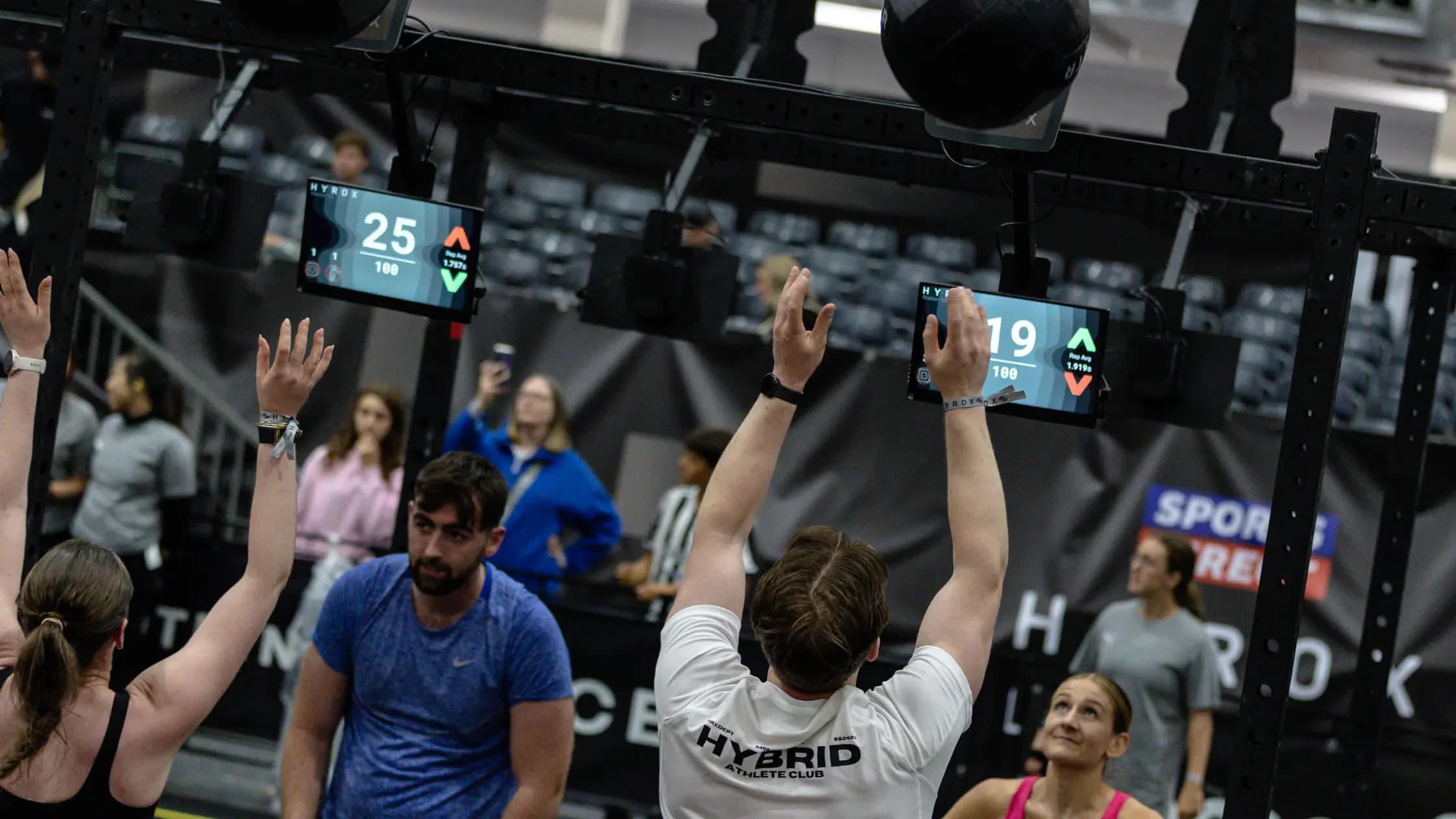
HYROX is one race with a published order. You run, you do a station, and you repeat that until eight runs and eight stations are done. This page is that race in plain terms: what the format is, what makes the work hard, and what you actually have to complete. The station-by-station standards are on HYROX stations and race format. The kilograms are on HYROX weights by division. Figures here are from the HYROX Singles Rulebook, Season 26/27.
HYROX explained
A HYROX race is 1 km of running followed by one workout station, eight times. The running adds up to 8 km in every division. Women, men, women pro, and men pro all run that distance. Pro does not add a ninth station or a longer run. It changes the weight on some of the stations.
The stations, in order, are the SkiErg, the sled push, the sled pull, the burpee broad jumps, the rower, the farmers carry, the sandbag lunges, and the wall balls. Wall balls are last. There is no run after them. You do the stations in that sequence. Missing a station, or failing to finish one, is a disqualification. Doing them out of order is a 3-minute penalty. More than one station out of order is a disqualification. You may go back and complete a missed station before the wall balls, and the penalty still applies.
The course is three parts. There is the run, the Roxzone, and the workout station. The Roxzone is the ground between the end of a run and the start of a station, and again when you leave the station for the next run. It has an IN arch and an OUT arch. The rulebook does not publish a Roxzone distance or a standard time to get through it.
Open and Pro share the SkiErg, the burpee broad jumps, and the rower. Those three do not get heavier in Pro. The SkiErg and the rower are 1,000 metres, with the damper preset to 6. You may change the damper. The burpee broad jumps are 80 metres with no external load. Pro is a heavier sled push, sled pull, farmers carry, sandbag, and wall ball.
You do not pick your own sled, rower, or wall-ball target. A judge assigns the lane and the equipment. On the sleds you stay in the lane you were given. On the lunges, the burpee broad jumps, and the farmers carry, a faster athlete can pass when it is safe.
Is HYROX hard
It is hard in a specific way. The hard part is not a mystery workout. The list is the same in every city. What is hard is doing that list in one go, with the runs starting as soon as you leave the station.
The first kilometre is the only one you start fresh. The kilometre after the SkiErg is already a different run, and the kilometre after the sled push is different again. That is compromised running. Training eight easy kilometres does not teach the seven runs that follow a station.
The stations that have a weight are heavy enough that they change the next run. In Season 26/27 the sled push, including the sled, is 102 kg for women, 152 kg for men and women pro, and 202 kg for men pro. The sled pull is lighter in every column, and it is still 78 kg, 103 kg, or 153 kg, including the sled, for 50 metres. The farmers carry is 200 metres with a kettlebell in each hand. The sandbag lunges are 100 metres, and the wall balls are 100 reps immediately after those lunges.
Open is the same order as Pro. A first race can be the Open loads. Pro is the same 8 km and the same three unloaded stations, with heavier sleds, carry, sandbag, and wall ball. Choosing Pro does not make the SkiErg, the burpee broad jumps, or the rower longer.
The standards are part of the difficulty. A wall-ball rep that does not reach the target, or a burpee that does not put the chest on the floor, does not count. You stay on the station until the work is valid. There is no separate clock that stops while a judge explains the standard.
How hard is HYROX
How hard it is depends on the division you enter and on whether you have practised the order, not on a single finish time this page can hand you. This site publishes average finish times by season, division, and age group on average HYROX times. Those tables are race results. They are not a pass mark.
Read the hardness off the work, division by division.
Women in the Open division push a 102 kg sled and pull a 78 kg sled, carry 2 × 16 kg for 200 metres, lunge 100 metres with a 10 kg sandbag, and throw a 4 kg ball to a 2.70 metre target for 100 reps. Men in the Open division, and women in Pro, push 152 kg and pull 103 kg, carry 2 × 24 kg, lunge with 20 kg, and throw a 6 kg ball. Men throw that 6 kg ball to 3.00 metres. Women pro still throw to 2.70 metres. Men pro push 202 kg, pull 153 kg, carry 2 × 32 kg, lunge with 30 kg, and throw a 9 kg ball to 3.00 metres.
The SkiErg is 1,000 metres before any of that, after one kilometre of running. The rower is another 1,000 metres, after 80 metres of burpee broad jumps. The wall balls are last, after the sandbag lunges and after 8 km of running. If the sled at your division does not move for 50 metres in training, or the wall-ball target is a height you have not thrown to, the race will be hard at that station specifically. The calendar of the event does not change that.
Doubles does not split the sled in half. Doubles women use the women’s Open loads. Doubles men, mixed doubles, and women pro use the middle column. Doubles men pro use the men’s Pro loads. Both people still have the runs. Sharing a station is a rule about who is working and where the resting partner stands. It is not a lighter race. Those partner positions are on HYROX doubles rules.
What does HYROX involve
It involves three jobs, repeated. You run 1 km. You cross the Roxzone through the IN arch. You complete one station to the standard a judge can see. You leave through the OUT arch and run again, until the wall balls replace that last run.
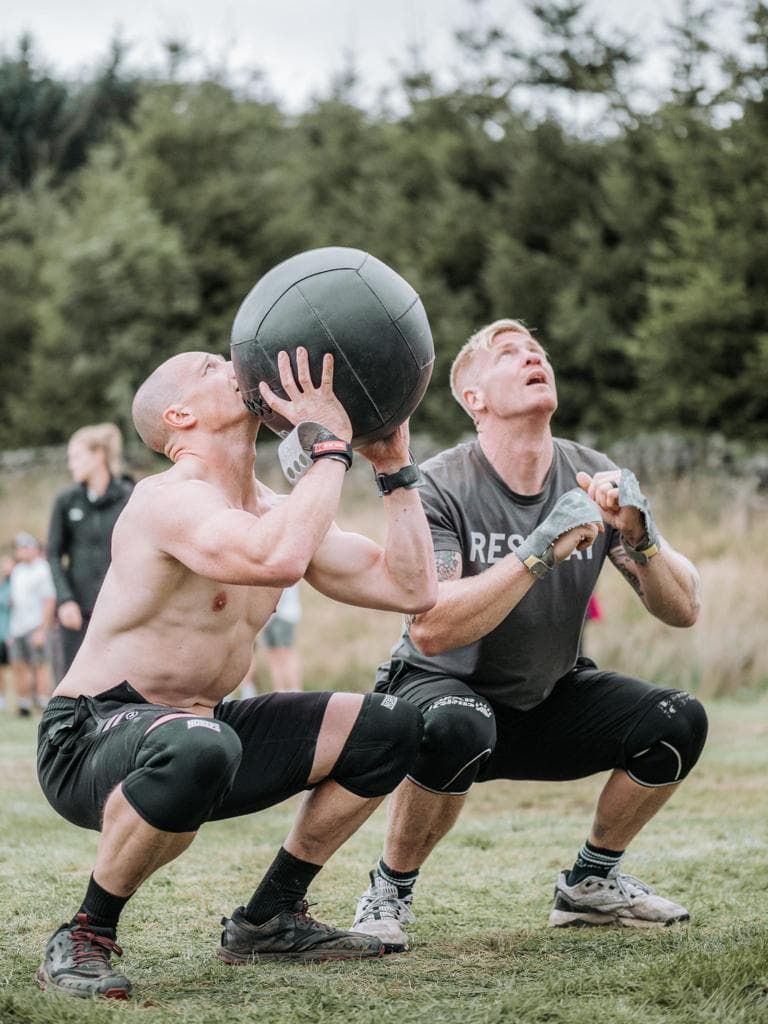
On the station, the standard is the work. The whole sled has to cross the line on each 12.5 metre length. The farmers carry is finished when the kettlebells are carried across the line and returned with the handles upright. The sandbag stays on you. A wall-ball rep starts standing tall, with both hands on the ball, a squat below parallel, and a throw to your target. Women and women pro throw to 2.70 metres. Men and men pro throw to 3.00 metres.
It also involves the bits between the stations that are still on the clock. Water is available at least once on each pass through the Roxzone. Anything you want to eat, you carry from the start. Litter left on the floor, and the wrong arch, are 2-minute penalties. Entering through the OUT arch or leaving through the IN arch is that penalty each time.
What it does not involve is a workout that changes from city to city. The order above is the race. A gym session that includes some of the movements is not the race. A HYROX simulation is the same sequence. The HYROX race calculator splits a finish time you choose across the runs and the stations. It does not change what you have to do.
Training for it, in outline, is on how to train for HYROX. The short version is easy running, time on the stations at the real distance, one session where a station is followed by a run, and strength work that includes a carry and a lunge. That page is the outline. It is not a day-by-day program.
What does HYROX consist of
It consists of eight runs and eight stations, in this order.
| Order | Run | Station |
|---|---|---|
| 1 | 1 km | SkiErg, 1,000 m |
| 2 | 1 km | Sled push, 4 × 12.5 m |
| 3 | 1 km | Sled pull, 4 × 12.5 m |
| 4 | 1 km | Burpee broad jumps, 80 m |
| 5 | 1 km | Row, 1,000 m |
| 6 | 1 km | Farmers carry, 200 m |
| 7 | 1 km | Sandbag lunges, 100 m |
| 8 | 1 km | Wall balls, 100 reps |
That is the whole race. 8 km of running. No run after the wall balls. The sled push and sled pull weights include the sled. The farmers carry is one kettlebell in each hand. The wall-ball target follows whether you are racing as a woman or a man, not only which ball you were given.
Between each run and each station you are in the Roxzone. That section consists of a marked route, an IN arch, an OUT arch, and the water point. It does not consist of an extra station, and the rulebook does not give it a distance you can train as a ninth piece.
If you want the movement standard for one row of that table, use the technique page for that station. If you want the kilogram for your division, use the weights page. The list above is what the race consists of. The division decides how heavy five of the eight stations are. The other three, the SkiErg, the burpee broad jumps, and the rower, stay the same length in Open and Pro.
Related Posts


Our Tools
Leave nothing to Chance!
Our tools review your performances, optimise your training and strategise your races



Hey! How can we help?
02:29Didn't Find what you're looking for?
Drop us a message on WhatsApp or ping us an email. We usually reply within the hour.